
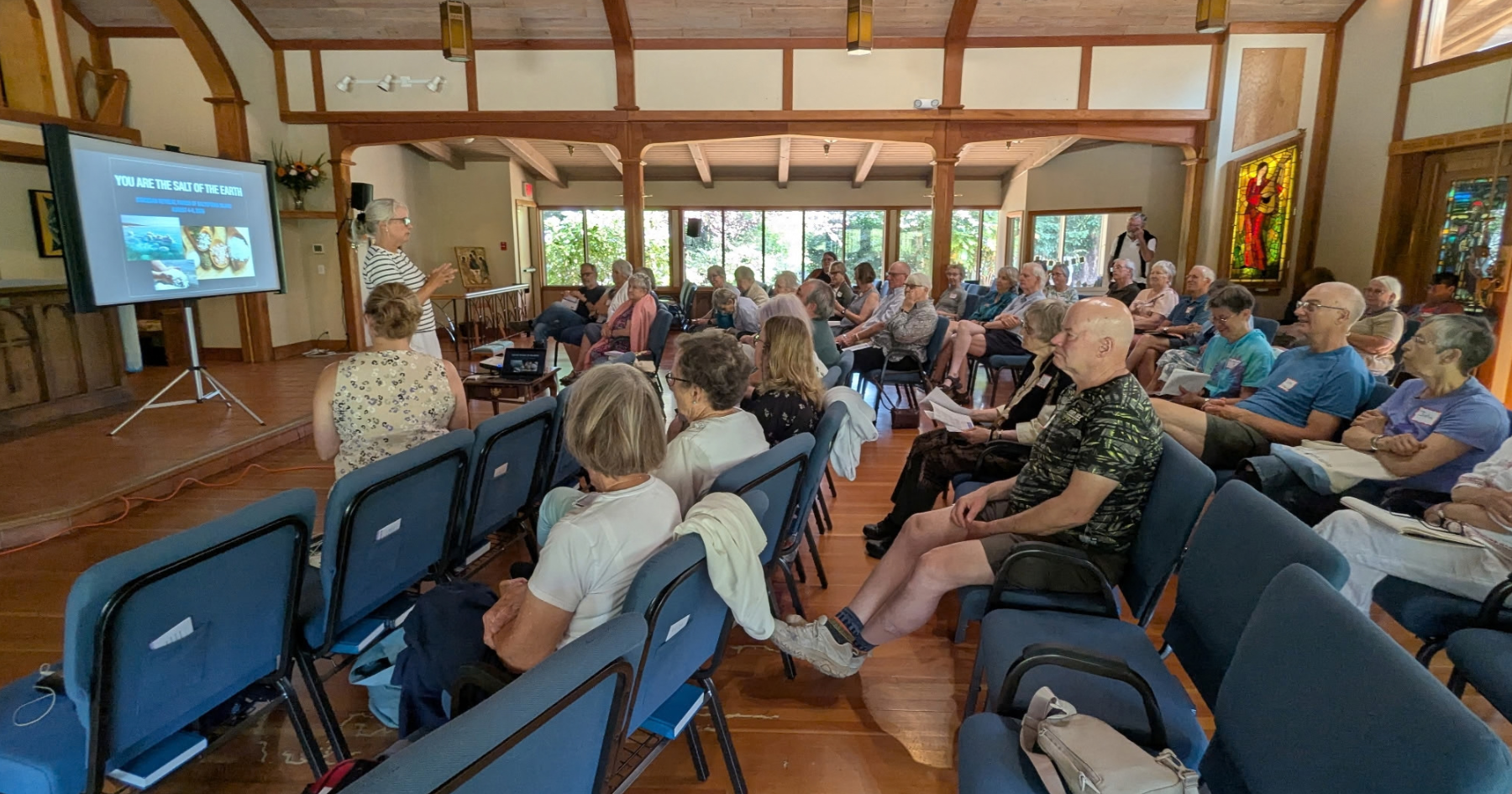
From the evening of Aug. 4 to midday on Aug. 6, 46 people joined Bishop Anna and Christine Conkin, incumbent at St. George, Cadboro Bay, for ‘You are the Salt of the Earth,’ a diocesan summer retreat on Salt Spring Island.
People came from 20 parishes, from as far north as Courtenay, all the way south to Victoria and the Southern Gulf Islands, together with a few people from Ontario, Alberta and the Diocese of New Westminster.
A subtitle to the retreat might well have been ‘How Salt Can Lose its Savour,’ as Bishop Anna and Christine focused on the history of empire and the church. One presentation slide defined empire as a “major political unit in which the metropolis, or single sovereign authority, exercises control over territory of great extent or a number of territories or peoples through formal annexations or various forms of informal domination.” One key point that pervaded the presentations and the discussion was that empires always turn violent. We see horrible examples of that today across the globe.

The retreat focused on acts of violence in the territory of the diocese; events where justice was entirely denied to First Nations people through unfair trials, summary executions and acts of great violence.
In addition to acts of violence, settlers to British Columbia brought diseases for which Indigenous Peoples had no immunity.
Smallpox, influenza, measles, and whooping cough were recorded epidemics, with smallpox particularly recurring with devastating effects in the native population…. It is clear that in some cases entire villages were significantly reduced in single disease events, with mortality rates ranging from 50% to 90% of the population. During this time there was a vaccine for smallpox, which was discovered in Europe in the late 1700s; however it was rarely provided to First Nations people. (From the website of the First Nations Health Authority)
Murder and disease were not the only forms of violence. Confiscation of land and property was also rife. Except for a few treaties in southern Vancouver Island, known as the Douglas Treaties, there were no other treaties in British Columbia. But even on Vancouver Island those treaties were frequently broken as land was confiscated, often under the fiction of terra nullius (land belonging to no one) or the fiction that the people were only hunters and gatherers. Both fictions were widely spread across the lands of the diocese.
On Salt Spring those fictions led to the pre-emption of practically the whole island and to no permanent Indigenous presence on the island. There is evidence of major Indigenous work on the island, including several large, human built clam gardens and whole areas of land kept unforested to permit the growth of camas lilies for food.
The church is committed to reconciliation, but we all need to understand what we are trying to reconcile. As a slide in the presentation at the retreat stated: it’s a sure sign you are living in an empire when there are huge parts of your history you don’t know about. The First Nations are clear that they are not trying to make us all go away, but reconciliation also means restoration of dignity and a base for future opportunity.
The intemperate and ignorant outrage in some quarters at the recent BC Supreme Court decision that the Cowichan Tribes have Aboriginal Title and fishing rights at the mouth of the south arm of the Fraser River speaks to an attitude that reconciliation is fine as long as it is cost-free. If we are the salt of the earth, we must stand with the Cowichan people and other Indigenous sisters and brothers to make reconciliation real.
In addition to the excellent presentations and serious discussions in the retreat, there was much opportunity for fellowship, worship and good times. Let us hope the retreat becomes an annual event. You are all welcome to Salt Spring Island!