
Every year, over half a million pilgrims walk into the huge cathedral square in Santiago, Spain. They come along different paths, from different countries, with different life stories and intentions for walking the Camino.
In English, the Spanish word “camino” literally translates into “path, road or way,” but these days “camino” most often refers to the Camino de Santiago, or the Way of St. James. The Camino is a network of pilgrim routes that lead to the cathedral in northern Spain where tradition has it that the remains of the apostle James are buried. Since it was created at the beginning of the 9th century, millions of pilgrims have walked into Santiago.
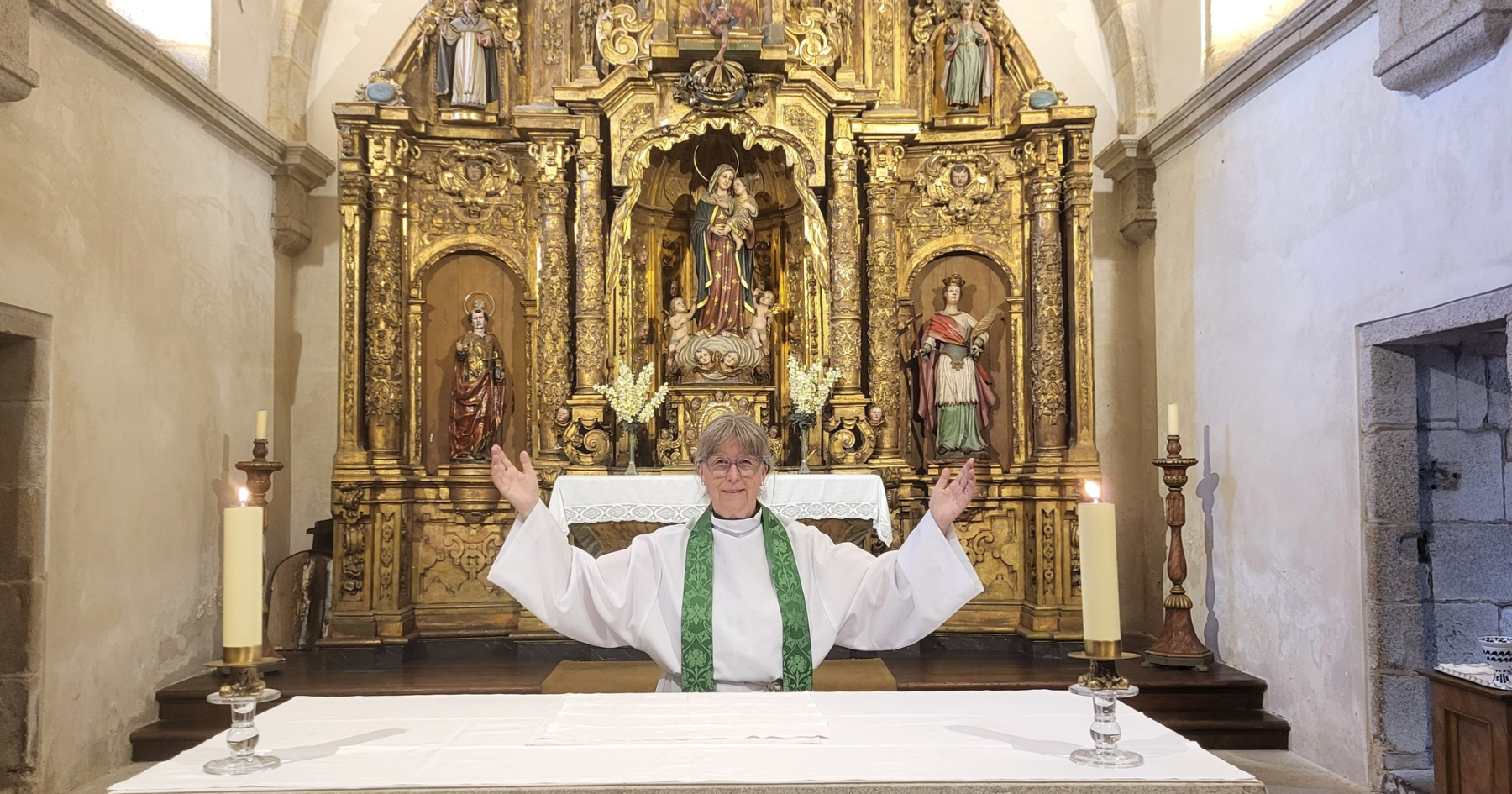
This past September my husband Jim Holland (also a priest in the diocese) and I traveled to Santiago to be volunteer chaplains for two weeks at a beautiful little church of St. Fiz, in the heart of the old city. This Roman Catholic church has been made available by the local bishop to Anglicans so they can provide services and support to Anglican pilgrims.

Jim and I kept the church open for several hours a day so tourists and curious locals could come in, look around, pray if they wanted and light candles for their intentions. We offered midday prayer and a 4 p.m. communion service every day.
We were housed at the Anglican Pilgrim Centre, a 10 minute walk from St. Fiz. And so, every day I would head out with my collar on for the “commute” to the church. And every day, I was acutely aware of eyes on me. In a country that has been, and still is, predominately Roman Catholic, the sight of a woman clergy is unusual. Of course, I could not know what people were thinking but I sensed people’s curiosity, and in some cases, hostility.
Jim and I took turns celebrating the eucharist and as people strayed in and out of the church, I noted people’s response to seeing a woman presiding and preaching. I took some pleasure in exposing people to what might have been a new reality for them.
I remembered my own experience as a Roman Catholic seeing a woman up at the altar for the first time in the 1990s. The bishop had a nun serve him at the altar one Sunday. It was a life-changing moment for me. I was absolutely stunned. I hadn’t realized until that moment what had been missing. The revelation, not talked about or spoken to, was simply present. My eyes were opened.
This memory came flooding back in full colour when I was sitting near the doors of St. Fiz, writing in my journal, when a Spanish-speaking woman and her mother approached me. I speak very little Spanish and the woman spoke very little English, but I knew right away what she was wanting to know when she pointed to my collar.
“Yes,” I answered, “Sacerdote.” When she looked confused, I added, “But not Roman Catholic, Iglesia Anglicana.”
Her face lit up, she grabbed me and hugged me. She translated for her mother, whose face also lit up, and then they asked for a selfie with the three of us. That was a special moment.
But there were moments when I wondered why I was putting myself in the public eye as I walked through the town in my collar at least twice a day. I felt vulnerable, especially when walking alone. I didn’t enjoy the attention. I especially didn’t enjoy the negative attention I seemed to attract at times. I found it stressful some days.
One day I was walking alone, feeling quite vulnerable, wondering why I was putting myself out there, thinking maybe I wouldn’t wear my collar through town anymore and put it on at the church instead. As I was musing, I felt someone’s hand on my arm. I turned around. An elderly man addressed me. He didn’t speak English and asked if I spoke “French? Italian? German?” Reluctantly I said “no, no, no.” And then he shrugged, pointed to my collar, gave a big smile, gave two thumbs up and squeezed my arm. I was delighted and my mood changed instantly. I went on my way sending up a word of thanks for the exact encouragement I was needing.
This month we are celebrating 50 years of the priesting of women. I have been a priest 10 years now and have only had a taste of what it’s like to be a pioneer. My time at St. Fiz and in the old city of Santiago gave me a sense of the ups and the downs so many of my women colleagues know all too well. It’s part of being a pioneer and being on pilgrimage. It’s a journey; and it’s a good and necessary one for us as individuals and for all of us a church.
And it’s something to be celebrated. The missing piece in the picture has been re-discovered.