“Yo soy el camino, la verdad y la vida.” (John 14:6)
In June 2026 I was privileged to be a member of the final Accessible Camino group to walk or roll the final 111km of the Camino Francés from Sarria to Santiago de Compostela.
Accessible Camino was born out of a 2014 walk by Patrick Gray and Justin Skeesuck along the full Camino Frances, from St-Jean-Pied-de-Port to Santiago de Compostela. Justin lives with a degenerative neuromuscular condition akin to ALS and uses a wheelchair full-time. Patrick Gray is his lifelong best friend. When Justin expressed his desire to travel the Camino, Patrick immediately said “I’ll push you.” I’ll Push You is the title of their book and of the award-winning documentary about their journey. As the Accessible Camino project reaches its conclusion this year after a decade of operation, another documentary is being made, entitled More Than Steps.

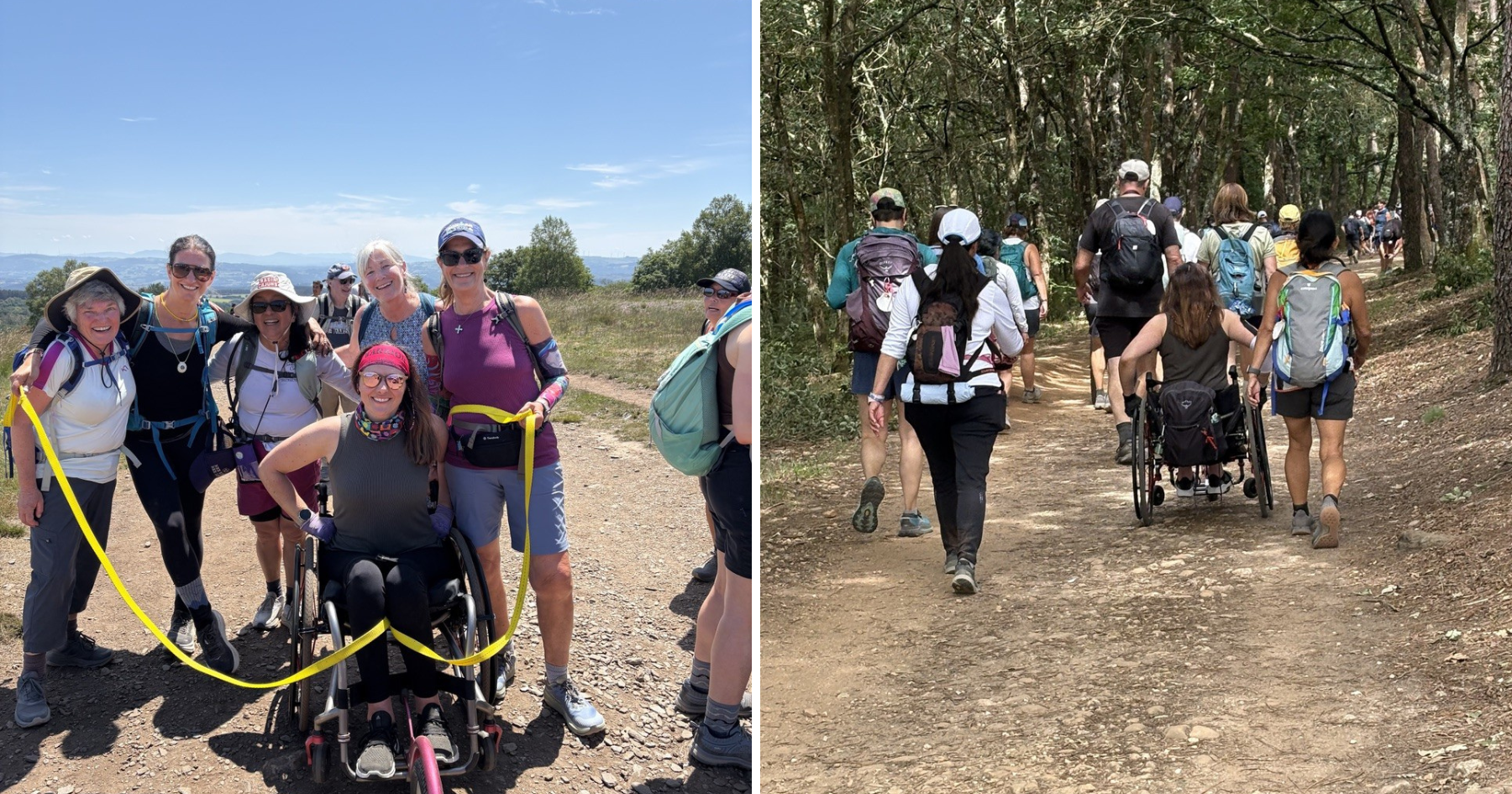
We were seven wheelchair users, forty helpers, five guides and a three-person film crew. We were all people of faith. Our week together was more about community, love, commitment and trust than it was about the physical ability to travel the Camino by whatever means. The captains (the wheelchair users, themselves exceptionally fit) called the shots in how much and what type of assistance they wanted in any given situation. The rest of us were there to provide whatever support was requested. Sometimes it was a little hair raising to watch a wheelchair careening down a hill!
The pace was also set by each captain, and unless the terrain was quite rough, that meant moving at a good clip. Pulling or pushing uphill was a lesson to me in how “many hands make light work” — usually I felt little additional strain beyond the challenge of maintaining the pace. Things worked more easily if I was teamed with someone about the same stature as myself, but it was a different story when I was paired with someone nearly a foot taller and 30 years my junior! I quickly learned that I don’t weigh enough to be an effective brake. I learned so much about what “accessibility” means, and about life in a wheelchair. More importantly, I now see wheelchair users as whole people.
For the captains, the ability to chat to their team members was as important as being assisted to physically move down the trail. For those in our group who were nursing sore knees or other injuries, their role became to support the social aspect of the journey by simply walking alongside. Given that we ranged in age from 17 to 81 and were of a wide array of body types and athletic abilities, it was a lesson to me that we each play an important role in community no matter what our gifts or talents.
Overwhelming emotion was a key feature of our week together, and many of us often found it impossible to speak without choking up. Tears of relief flowed when all the captains safely made it across a series of large, uneven stones across a stream. Most wheelchairs were slightly wider than the stones, and the danger of slipping sideways into the water was palpable. About a dozen “spotters” waded into the stream to prevent a catastrophic slip, while others walked backwards across the slippery rocks to guide the way.
There was one exception to the rule about not working with a specific captain. One captain developed a pressure sore that became so dangerous his accompanying therapist advised him to stop his journey as surgery was going to be necessary. The captain was adamant that he wanted to continue, so some in our group were asked to stay with his team for the duration.
Any time there was a bump or rough ground, he and his chair had to be lifted. Because of the location of his pressure sore, any time there was a downslope he had to be wheeled slowly down backwards. I am not a believer in faith healing, but somehow a miracle happened: the day before we reached Santiago, his pressure sore reduced by half. That should have been impossible.
It was a week like no other. We had lots of fun together, dancing and joking and wearing body glitter and going out for gelato at what is normally well past my bedtime. Our fabulous team of Spanish guides and the film crew were as integral to our safety and our enjoyment as the rest of us. We were treated very well, with frequent water and fruit breaks, five-star hotels (lesser hotels could not have accommodated such a large group and meet our accessibility needs) and good restaurants for our evening meals.
Our final gathering as a group was for a banquet in the Parador next to the cathedral in Santiago. Who knew that apple pie goes perfectly on the plate next to roast beef and gravy? In his closing remarks, Patrick Gray said that this was the conclusion of the Accessible Camino project because “it is complete.” So complete was my experience that I suspect that I will not walk another Camino; I have been given all I need by The Way.