Diocesan council is grateful to the parish of St. Peter, Quamichan for hosting most of our meetings in their lovely hall. Not only is it a lovely setting but meeting at St. Peter’s means the folks from further north in our diocese are at least spared the Malahat.
At our March meeting, Brendon facilitated a conversation about St. Peter’s “Our Land Story,” a report prepared by Jesse Robertson, a Christ Church Cathedral parishioner with a PhD in history from the University of Victoria. Brendon asked us what we were impressed by, but also what made us uncomfortable. Many of us were impressed to read that in 1867 an Anglican lay person who served as a catechist to the Hul’q’umi’num, William Henry Lomas, also vaccinated against smallpox as part of his ministry.
At the same time, we were all shocked to learn the very violent colonial history of the area. In 1856, James Douglas, the first governor of British Columbia, sent two naval vessels and over 400 men to the valley. So’mena (Somenos) Chief Tathlasut was accused of attacking a settler (many suggest it was provoked). He was captured and hung from an oak tree not far from St. Peter’s.
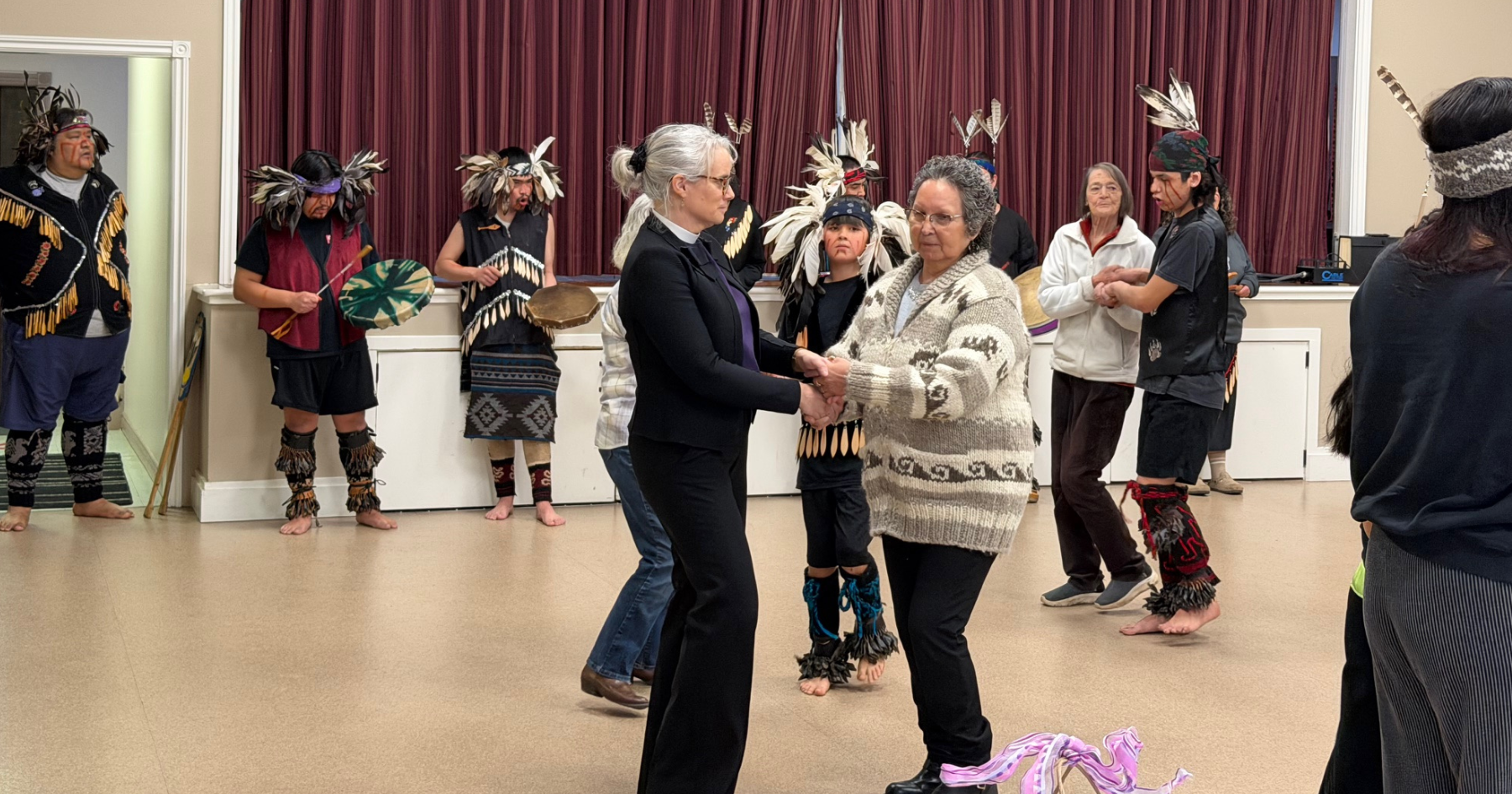
It was with this history in mind that the Monday after our March diocesan council meeting, I attended a ground blessing service just a few kilometres from St. Peter’s, again on unceded Cowichan lands, at St. John the Baptist, Duncan. Our parish there has sacrificially offered up a good portion of their property so that affordable housing can be built. Having met on the Sunday to say goodbye to their beloved hall, we gathered again on Monday with Cowichan Chief Cindy Daniels and about a dozen Cowichan Dancers to bless the land that the housing will be built upon.
To prepare for Monday’s event, I read over the land story for that property. In that report I learned how, in 1866, concerned about the increasing violence and dispossession they were experiencing, a number of Hul’q’umi’num chiefs travelled to Victoria to try and talk to James Douglas. When Douglas was not available the chiefs instead met with the first Bishop of this diocese, Bishop Hills. There is no record of what happened after that meeting but history suggests that Bishops Hills did not advocate for the Hul’q’umi’num.
Funding was cut for that hard-working lay catechist and by 1884 St. Peter’s incumbent, David Holmes, expressed the difficulty of continuing Indigenous mission work singlehandedly. “No means have been furnished necessary to carry on the work. Stipend has been discontinued. Work among Europeans has taken the place of Sundry services.” By 1885, Holmes’s successor, H.B. Owens, reported: “All Indian work has been stopped.”
As I watched the Cowichan dancers, most of whom were school-aged boys in wonderful regalia, and listened to the drums and singing, I reflected on how many generations of young Cowichan were not able to dance, drum and sing and how the church was a part of that dispossession and harm. It was as these thoughts were going through my head that it was announced that the next dance was a friendship dance. Before I knew what was happening Chief Cindy came over to me, held out her hands and said, “Come on bishop, let’s dance.” There was nothing to do but give thanks for her grace and follow her lead.
I share this story because for me it is a story both of repentance and of reconciliation and resurrection. Our history is at once beautiful and broken and our future is and will be bright. But to get there we must take a good honest look at ourselves and our story, know when to get out of the way so that something new can be born among us and, above all, know when to accept the invitation to dance.