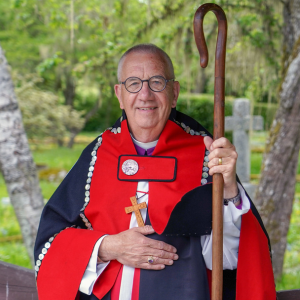
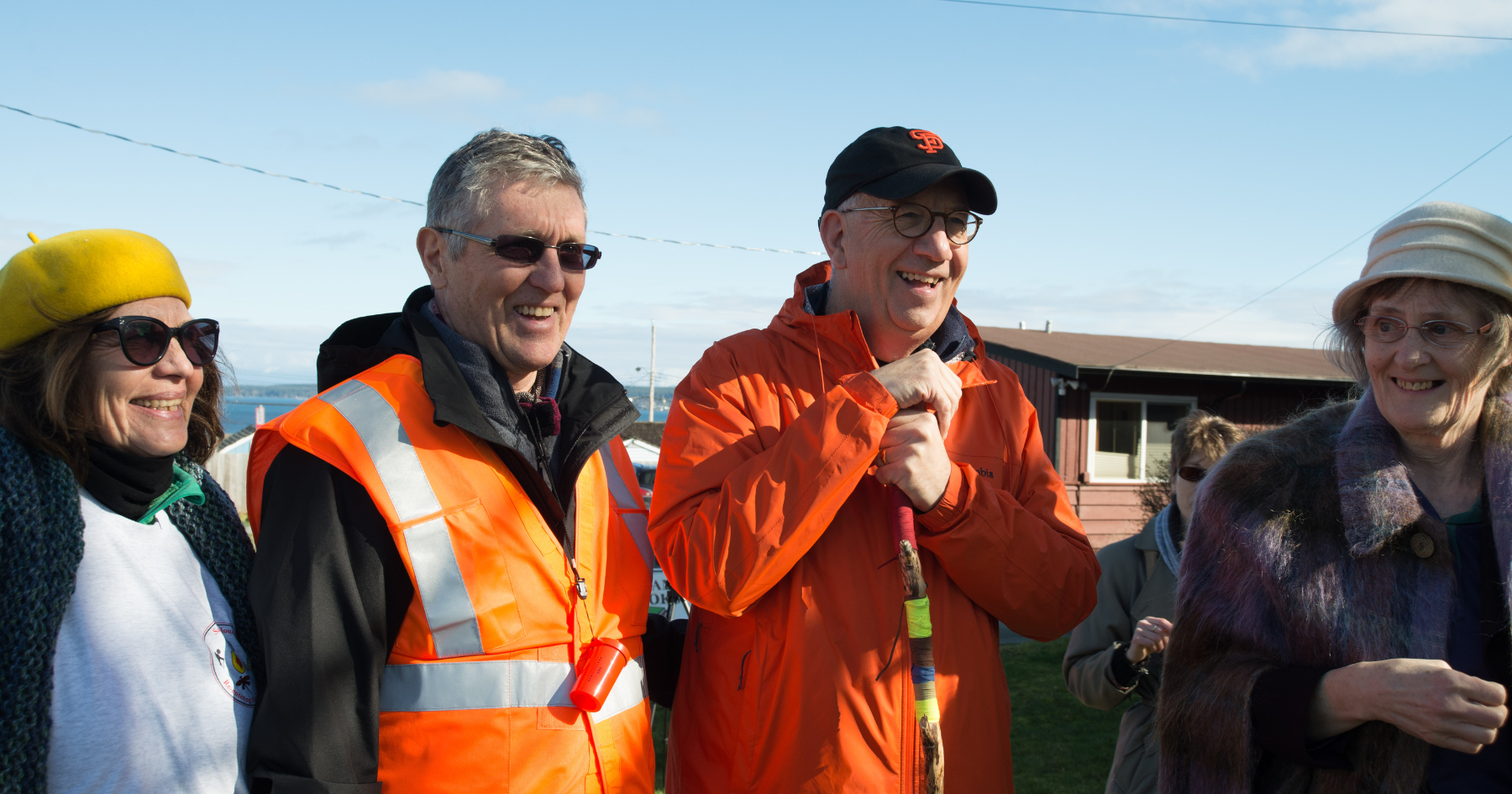
Ten years ago, in March 2016, a pilgrimage began in Port McNiell as an act of penance for the sins of a colonial past that would culminate over 460 kilometers later, on the steps of the Cathedral in downtown Victoria on Easter Sunday.
Ten years on, it is time to remember the First Nations communities visited and the relationships formed, the parishes who welcomed and fed us and gave us a place to rest, the volunteers who made the journey happen and those who walked with us and prayed that our feet would hold up. Among many, we especially remember the drivers Jeff, Wally, Doug and John, and Marcia who provided support along the way.
Ten years on, it is time to remember why the Sacred Journey was undertaken and to recognize that while the pilgrimage was an early step, the work is not done. These memories of the past are offered as a contribution to the efforts of the present.
Anglicans arrived on these islands and inlets as part of a colonial project. Our church was entangled with colonial power and participated in the Residential School system — one of the largest Residential Schools in Canada was in Alert Bay. This history continues to shape relationships, inflict wounds and point to obligations that cannot be ignored.
The goal of the Sacred Journey was to symbolically re-enter the land, but to do so differently. We sought first to recognize that we did not bring the Creator with us. The Creator was already here, present in the land, sea, sky and, most importantly, in the Peoples already here, known in their languages, worldviews, songs and ceremonies.
To acknowledge these truths, we set out to walk from Alert Bay to Victoria, stopping in each of the traditional territories we crossed. In each place, we sought to apologize for the church’s role in Residential Schools, to ask permission to enter the territory and, where invited, to stay, listen and honour the people of that place by offering to journey with them toward reconciliation.
The responses from communities varied, as we expected they would. Some welcomed us, some were cautious, some were rightly skeptical. Each response was a gift, reminding us that reconciliation cannot be demanded or rushed, only received with humility, patience and respect.
This was never just a symbolic walk. It was a spiritual discipline, a public confession and a commitment to walk differently in the future, together where possible and always with honesty about the past. The Sacred Journey provided a starting point for efforts that continue under new leadership, as Anglicans move forward on the important path to reconciliation and hope, in recognition that the work is not yet done.