
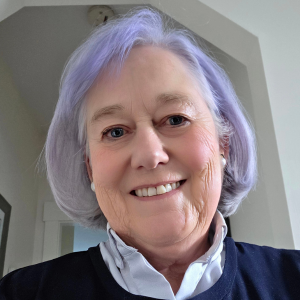
Tell us something about your background: where were you born and where did you grow up?
I was born in England but only lived there until I was about four years old. My father was a pilot, so we travelled extensively during my youth. We moved from Ontario to Nairobi, Kenya, back to Ontario, and eventually out to British Columbia. My father loved exploring new opportunities and was quite adventurous, whereas my mother was the exact opposite and more cautious by nature. I think I inherited both of those traits, which sometimes battle with each other!
In my youth, I had two deeply spiritual experiences, one when I was only about five years old. These moments have stayed with me my whole life, shaping my spiritual journey and my deep faith and trust in God. Though I could never fully explain them, they left me with a sense of awe, profound joy, and gratitude.
My mother was very active in the Anglican church when I was growing up, so I sang in the choir and helped with children’s programs. I remained active until my late teens when I moved to Vancouver on my own. That marked the beginning of my “spiritual but not religious” phase, perhaps reflecting my father’s adventurous spirit when it came to faith. During this time, I participated in many different personal transformation programs, some of which shaped the career path I was stepping into.
I didn’t return to the church until much later, when I was blessed with the opportunity to adopt a baby girl from China in the late 1990s. When we arrived home, I felt a strong call to return to a spiritual practice that was more grounded and established. This led us back to St. Andrew’s in Langley, the church I had attended as a teenager. I was very fortunate to have a priest there who encouraged me to step more fully into service. I became a liturgical assistant and was ultimately ordained as a deacon in the Diocese of New Westminster about 11 years ago.
Tell us a bit about your previous work, both within and outside the church.
I initially attended Simon Fraser University (SFU), where I received a bachelor of education, and taught briefly in the school system. I then transitioned into adult education, working primarily in the healthcare sector. I don’t remember exactly when I discovered the world of leadership and organizational development (OD), but it became my passion for over 25 years. During that time, I pursued a master’s degree in adult learning in the workplace at the University of Calgary.
I have always felt privileged to work in this field alongside deeply dedicated and committed people in healthcare. As part of my work with the Fraser Health Authority, I designed and facilitated a leadership development program, working with 40 cohorts of leaders. We don’t necessarily think of workplaces as oppressive, but because they are often built on colonial systems and thinking, they frequently are. The work of OD is to make these oppressive systems visible and to support the design of processes and structures that align with the human spirit, freeing people to be all they were created to be. In many ways, I view this work as a bridge between human values and the world of business.
How do you see the role of a deacon within the church?
It is an exciting time to be a deacon as we commit to the renewal of the diaconate. I recently stepped into the role of director of deacons for this diocese, and it is my privilege to support our growing community. We are fortunate to have deacons serving in a wide range of ministries, all working to build bridges between our worshipping congregations and the communities beyond the walls of the church.
What is particularly interesting to me, however, is that diakonia (leadership through service to others) is not reserved for deacons alone. It is the responsibility and calling of all of us. I believe the role of a deacon is not only to do the work directly, but also to inspire everyone around us to find their own calling within the ministries of service, healing and justice. These days, there is frequent conversation and concern about how we grow the church, and I believe this is the doorway. Christ calls all of us to servant leadership. Deacons can represent that calling, inspiring us all to bring our unique gifts more fully into the world.